Introduction
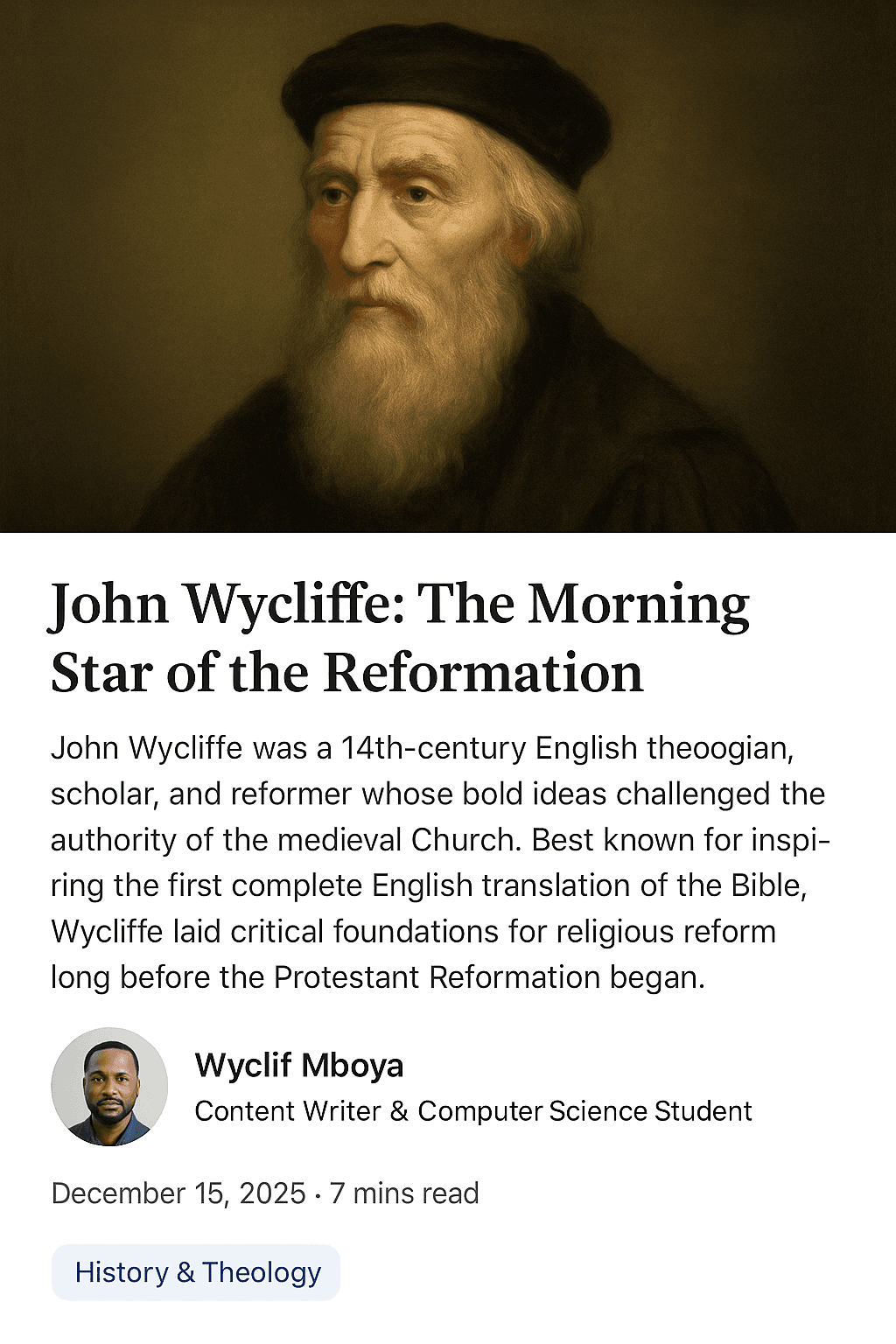
John Wycliffe (c. 1330–1384) stands as one of the most influential religious thinkers in English history. At a time when the Church wielded immense spiritual, political, and economic power, Wycliffe questioned its authority and practices with remarkable courage. His insistence on the supremacy of Scripture and his commitment to making the Bible accessible to ordinary people earned him the enduring title “The Morning Star of the Reformation.”
Academic Life and Intellectual Foundations
Educated at the University of Oxford, Wycliffe distinguished himself as a philosopher and theologian. He became deeply involved in scholastic debates and later earned a doctorate in theology. His academic grounding gave weight to his arguments and allowed him to engage critically with both Church doctrine and political authority.
Criticism of Church Authority
Wycliffe believed that true authority came from God and that neither kings nor church leaders could legitimately exercise power if they lived in sin. He strongly criticized the wealth, corruption, and political entanglements of the Church, arguing that it had strayed far from the simplicity of early Christianity.
One of his most controversial positions was his rejection of the Church’s doctrine of transubstantiation, which held that bread and wine literally became the body and blood of Christ during the Eucharist. This stance placed him in direct conflict with official Church teaching.
The English Translation of the Bible
Wycliffe’s most lasting contribution was his leadership in translating the Bible from Latin into Middle English. At a time when Scripture was largely inaccessible to the general population, this effort empowered ordinary believers to read and interpret the Bible for themselves.
Although the translation was completed by his followers, Wycliffe’s vision and guidance were central to the project. This work challenged the Church’s monopoly over biblical interpretation and reinforced his belief that Scripture, not clerical authority, was the ultimate source of truth.
The Lollards and Opposition
Wycliffe’s teachings inspired a movement known as the Lollards, who spread his ideas throughout England. The Church responded with condemnation, and many of his doctrines were formally denounced. Despite this, Wycliffe himself avoided execution and spent his final years as rector in Lutterworth.
Legacy
After his death, Wycliffe was posthumously declared a heretic, and his remains were exhumed and burned. Yet his influence could not be erased. His ideas shaped later reformers, including Jan Hus, and anticipated the theological arguments of Martin Luther and others in the 16th century.
Today, John Wycliffe is remembered as a pioneer of religious reform, a champion of Scripture in the vernacular, and a symbol of intellectual resistance against unchecked authority.